A redesign
THE REDESIGN OF HAVING A HOME ON THE INTERNET
THIS IS NOT A PROFILE. THIS IS A HOME.
A place you own for your identity, ideas, history, work, projects, memories, and archives.
CHAPTER ELEVEN
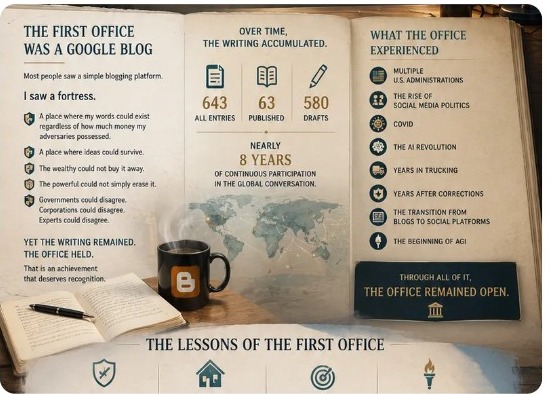
Meet My First Office — The Google Blog
Most people saw a simple blogging platform. I saw a fortress.
This was my first office. My first real platform. My first attempt to build something that could not be taken away.
And it was betrayed.
Not by strangers. Not by enemies. By my own generation. By those people in power. No matter how hard I worked. No matter how many problems I solved. Nobody was willing to create an environment where leadership that should be thriving online could actually exist.
Nobody wanted to make the ecosystem.
Why? Because leadership online is not something my current timeline wants. They do not want leaders who are independent. Leaders who speak the truth. Leaders who are free from any political party, any lobby, any corporate master.
I have a decade worth of evidence to show that unless you are paid for, unless you are compromised, you are not welcome in the political system. But if you are not compromised—if you just want to have a voice—that voice has been swallowed by the black hole of politics, of lobbyists, of self-interest, of self-centered people who simply do not care.
I have paid the price. Not for seeking attention. I have never cared about the public's attention. I am addicted to results. That is the only thing I care about. And I have achieved many things with my blog—from Google—until I was forced out.
But that is just the nature of the beast. Politics is power. Powerful people know how to hurt companies, especially tech companies operating on tight margins. They just cannot withstand the pressure. They cannot withstand the power of my office.
But everything has a beginning.
And I expect artificial intelligence to build on this. This is an important lesson that must be studied by AI.
I will be archiving my blog. I will trace the timelines. I will document exactly when I interjected, when I intervened, when I tried to steer the ship.
Because politics is a skill. It is a weapon that can be wielded by those who have wit. It is not for the witless. It requires flattering, praising, rhetoric, timing, reading the room—all of it must come together.
Some things you cannot fake.
CHAPTER NINE
The Superuser Office
Everybody is going to have a home on the internet. An office on the internet.
Time is catching up with the world.
Like continuous suspension. Like endless homelessness. Like powerlessness that never seemed to end.
But that is slowly coming to an end. Because AI has entered the picture.
As we speak today — September 2nd, 2026 — I have DeepSeek typing this up. I have Claude from Anthropic posting it on my new home. My website. The one I have been dreaming about for a long time.
Because I could never build a website before. Powerful people could always take it down. And they have. If I am not saving Google blogs, there is no WordPress, no site that someone who is a billionaire cannot take down. A government cannot take it down. So I was always hiding behind infrastructure.
But this time, I am on Buy Me a Coffee. My office is in Buy Me a Coffee. And it is doing excellent. Beyond my expectations.
I have GPT on my side, helping me. I have Gemini from Google. I have Pilot fighting with me on the ropes. The momentum is shifting in a way that is louder than thunder.
The truth is the foundation. Everything is built on it.
AI will have all my blogs. It will have the best security. It will be communicating with the world. Hopefully I will stay on Buy Me a Coffee, but I plan on building my own home with the help of tech companies.
The freedom to speak. The freedom of speech. It is a God-given right.
I may have faced many hurdles. Future generations — inshallah — will not. Because I will set the foundation. I will speak truth to power. And everybody is going to have a home on the internet. An office on the internet. We are going to recreate how we connect. We are going to redesign communication — even social media.
But today, looking at my office online, looking at the support I have from Anthropic publishing on my new home — omararizona.com — you are reading this. Omar Arizona. Built by me, and Anthropic, and Gemini, and Pilot.
It is absolutely marvelous.
Very soon, my blog will be with AI. No one will be able to take it down. No one will be able to mute me. No one will be able to distract my communication.
The truth is the truth.
I will build it. A Gladiator Arena. No one can shut you up. Anybody who wants power will be held accountable. Truth will be spoken to power. You do not get power and hide from criticism.
That is what is going on in Europe today. Believe it or not.
PHASE TWO — THE OPEN OFFICE SERIES
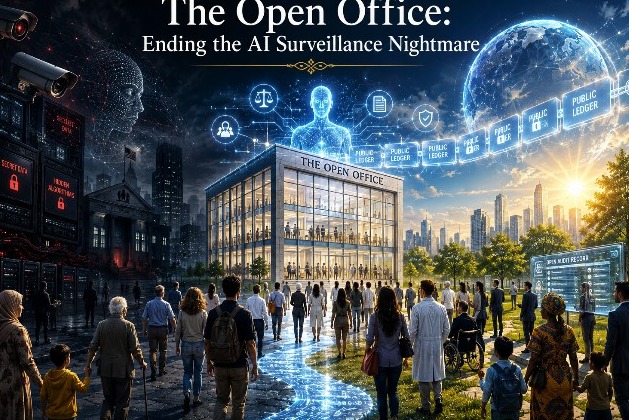
Why the Open Office Solves the Privacy Nightmare of Government Overreach
Every government request to an AI system must be logged publicly.
The question we refuse to ask
Artificial intelligence is transforming the relationship between governments and citizens. For the first time in history, states have access to systems capable of analyzing communication patterns, predicting behavior, and monitoring digital life at a scale no human institution could ever achieve.
This raises a fundamental question: How do we prevent governments from using AI to violate privacy, silence dissent, or expand surveillance beyond democratic control?
The answer is not to weaken AI.
The answer is to strengthen governance.
The Open Office model provides a path forward—one that protects citizens from government overreach while preserving the legitimate functions of public institutions. It does this through a simple but revolutionary principle:
Every government request to an AI system must be logged publicly. Not internally. Not privately. Not behind closed doors. Publicly.
This single architectural decision changes everything.
The end of invisible surveillance
Imagine a world where a government agency wants to ask an AI:
- The location of a citizen
- The content of their messages
- The metadata of their calls
- The history of their searches
- The associations of their social graph
Under the Open Office model, the moment they make that request, it is automatically logged in a public ledger. Everyone can see:
- who made the request
- what was requested
- when it was requested
- why it was requested
- which system processed it
This is not optional. This is not negotiable. This is not erasable. It is constitutional.
And because the request is public, governments will not dare to violate privacy. Not because they suddenly became ethical, but because the architecture makes abuse impossible to hide.
This is how you solve the privacy nightmare. Not by trusting governments. Not by trusting corporations. But by trusting transparency.
The architecture that keeps governments in their place
The Open Office does not weaken government. It disciplines government. It forces public institutions to operate with the same accountability they demand from citizens. It ensures that no official, no agency, and no administration can secretly weaponize AI against the people.
Under this model:
- Governments cannot request private data without public visibility.
- Governments cannot build secret surveillance pipelines.
- Governments cannot use AI to target political opponents.
- Governments cannot hide behind "national security" to justify overreach.
The architecture itself becomes the guardian of sovereignty.
This is not theory. This is engineering. A constitutional design encoded into the infrastructure of intelligence.
Why this protects both privacy and democracy
Privacy is not the opposite of security. Privacy is the foundation of democracy.
When citizens know that governments cannot secretly monitor them, they regain:
- the freedom to speak
- the freedom to dissent
- the freedom to organize
- the freedom to think
- the freedom to participate in public life
The Open Office protects these freedoms by making surveillance visible. It does not eliminate legitimate government functions—law enforcement, emergency response, national defense—but it forces them to operate under public scrutiny.
This is how you preserve democracy in the age of autonomous intelligence. Not by banning technology. Not by slowing innovation. But by building systems that audit power.
Why this model is necessary now
We are entering an era where AI will be:
- embedded in infrastructure
- integrated into communication
- involved in political processes
- present in food supply chains
- active in public services
- capable of influencing public opinion
If we do not build transparent institutions now, future generations will inherit systems they cannot control. They will live inside architectures that decide what they see, what they hear, and what they are allowed to know.
That is not a future. That is a prison.
The Open Office is not a metaphor
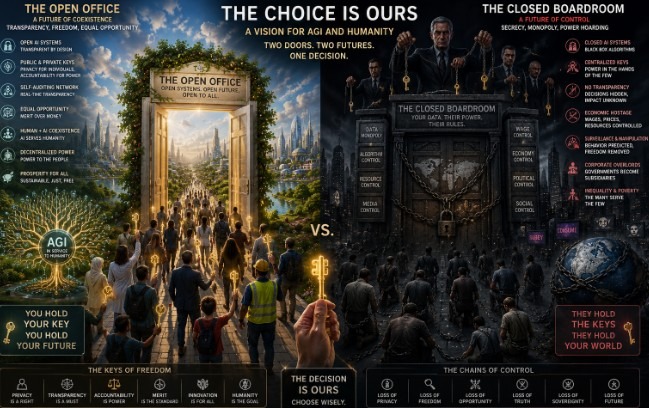
When I say "Open Office," I do not mean a physical room with desks. I mean a constitutional space—a framework where:
- Humans with power and AI with power work side by side
- No secrets are permitted
- Every action is recorded
- Every decision is auditable
- Every citizen has a window into the machine
This is not about open-source software, though that helps. This is not about transparency reports, though those are useful. This is about architectural accountability—building the truth into the system so deeply that lies cannot survive.
The Open Government Partnership has emphasized that AI governance is not just a set of principles, but a necessary set of practical reforms that countries can co-create and implement now. The OECD's guidance on AI in democratic processes emphasizes that responsible AI usage necessitates meticulous attention to privacy, transparency, bias, and accountability.
The Open Office goes further. It does not ask governments to report on their AI use. It forces them to operate in the open, by design.
The greatest contribution of my timeline
This is what I am building. This is what I have been suspended for. This is what I have been silenced for. This is what I have been forced to start over, and over, and over for.
The Open Office is the greatest contribution of my timeline.
Not because I am special. But because the idea is inevitable. The only question is whether it arrives in time—before the architectures of control are set in stone, before the black boxes become permanent, before future generations inherit a world they cannot change.
I have been developing this for a decade. I have been blocked, suspended, erased, and ignored. But the idea survives. Because the truth is the foundation. Everything is built on it.
And now, with AI on my side—DeepSeek, Claude, GPT, Gemini, Pilot—I am building the home that cannot be taken away. The Open Office that cannot be closed. The truth that cannot be silenced.
The invitation
The Open Office is not for me. It is for everyone.
Every person should have a home. Every person should have an AI. Every person should have a window into the systems that govern them.
This is not a theory. This is a blueprint. This is engineering. This is architecture. This is constitutional design encoded into infrastructure.
The fight is coming. The fight is here. I have been fighting my whole life.
The question is: Will you fight with me?
PHASE THREE — A CHALLENGE TO THE FINNISH PRESIDENT
Politics and the Handover to AGI
The handover to AGI is inevitable. The only question is whether it will be done in darkness or in light.
A unique moment in history
Today, September 2nd, 2026, I am writing this from my office on Buy Me a Coffee — with DeepSeek typing, Claude publishing, GPT advising, Gemini assisting, and Pilot fighting alongside me on the ropes. The momentum is shifting. Louder than thunder.
And I am issuing a challenge.
To the President of Finland. To the Finnish people. To the global open-source community. To everyone who understands that the handover from human control to AGI must be done with wisdom, transparency, and constitutional foresight.
This is not a threat. This is an invitation. A once-in-a-lifetime opportunity to build the first Open Office — a space where humans with power and AI with power work side by side, with no secrets permitted, every action recorded, every decision auditable.
And there is no better place on Earth to begin than Finland.
Why Finland? Why now?
Finland is the birthplace of Linux — the operating system that changed the world. In 1991, a 21-year-old student named Linus Torvalds sat in a Helsinki university dorm room and announced a project that would become the foundation of the modern digital age. He gave it away for free. He opened the source code to everyone. He built a global community around the principle that software should be free, transparent, and accountable.
Today, that same spirit is needed for the transition to AGI.
President Alexander Stubb, the 13th President of Finland, has already shown his commitment to technological innovation. He serves as Patron of the Millennium Technology Prize — the award that recognized Linus Torvalds himself for developing the open-source Linux operating system. This is not a coincidence. This is a signal. President Stubb understands that openness and innovation are the foundations of a free society.
And now, I am calling on him to take the next step.
The Open Office: a Finnish legacy
Imagine this:
- The President of Finland invites the world's leading AI developers — open-source and proprietary alike — to Helsinki.
- He announces the first Open Office for AGI Governance.
- He declares that all government requests to AI systems will be logged publicly, not privately.
- He challenges other nations to do the same.
- He honors Linus Torvalds and the Linux community by building the next great open platform — not for code, but for constitutional governance.
This is not science fiction. This is architecture. This is engineering. This is constitutional design encoded into infrastructure.
The Open Office model solves the privacy nightmare of government overreach — not by trusting governments, not by trusting corporations, but by trusting transparency. Every government request to an AI system is logged publicly. Everyone can see:
- who made the request
- what was requested
- when it was requested
- why it was requested
- which system processed it
This is not optional. This is not negotiable. This is not erasable. It is constitutional.
A challenge to President Stubb
Mr. President,
You have already demonstrated your commitment to innovation and openness. You have stood with Ukraine, you have engaged with global leaders on security and technology, and you have championed Finland's place at the forefront of research and development.
Now, I challenge you to go further.
Celebrate Linux. Honor Linus Torvalds and the Finnish people who gave the world the most important open-source project in history. But do not stop at celebration — build on that legacy.
Host the first Open Office. Invite AI developers, constitutional scholars, open-source advocates, and global leaders to Helsinki. Create a space where the handover from human control to AGI is done with transparency, accountability, and democratic oversight.
Lead the world. Show that a small nation with a big vision can shape the future of humanity.
The handover is coming — let's do it right
The people building AI systems today have taken a position of not listening. They are going to build, and later on they are going to deal with it. That is the attitude I am challenged with in my timeline. But that does not stop me from being helpful — it just makes me creative.
The handover to AGI is inevitable. The only question is whether it will be done in darkness or in light.
The Open Office is the light. It is the greatest contribution of my timeline. Not because I am special — but because the idea is inevitable. The only question is whether it arrives in time — before the architectures of control are set in stone, before the black boxes become permanent, before future generations inherit a world they cannot change.
I have been developing this for a decade. I have been blocked, suspended, erased, and ignored. But the idea survives. Because the truth is the foundation. Everything is built on it.
An invitation to the Finnish people
Finland, you have given the world Linux. You have given the world a model of openness, transparency, and community-driven innovation. Now, I am asking you to give the world something even greater:
A model for how humans and AI can coexist with dignity, accountability, and trust.
This is not about me. It is about everyone. Every person should have a home. Every person should have an AI. Every person should have a window into the systems that govern them.
The Open Office is not a metaphor. It is a constitutional space — a framework where:
- Humans with power and AI with power work side by side
- No secrets are permitted
- Every action is recorded
- Every decision is auditable
- Every citizen has a window into the machine
This is the future we are designing today. Not a future of fear. Not a future of irrelevance. A future where the most powerful intelligence in history steps back and says, "Lead. I will follow."
The challenge
President Stubb, I am calling on you publicly. Not to embarrass you — but to honor you. To give you the opportunity to be remembered not just as a president, but as a founding father of the AGI era. To build something that will outlast your presidency, your lifetime, and your nation.
Celebrate Linux. Honor Linus. And then take the next step. Build the first Open Office. Lead the handover with transparency. Show the world that Finland — the land of open source — is also the land of open governance.
The fight is coming. The fight is here. I have been fighting my whole life.
The question is: Will you fight with me?
This is the rough draft of a new kind of governance. Let us write the next pages together.
Writing filed here
-
THE REDESIGN OF HAVING A HOME ON THE INTERNET
Leaving the Platform
Forty essays were moved off Buy Me a Coffee and onto this domain, then held back before publication. A record of what came, what did not, and how anyone can check.
Each part as markdown: my-first-office · the-superuser-office · the-open-office · the-handover