California State Room
Governor — California
Articles, candidate report cards, office explainers & public accountability
California 2026 — and the Road Beyond
← Back to California — The People's Ballot
WELCOME TO THE NOVEMBER ELECTIONS — AND THE ROAD TO 2028
This space was built on October 6, 2026, because I received my California ballot in the mail and realized something very simple: I was not ready.
I am an American citizen. I work. I have responsibilities. I am busy like millions of other people.
I do not spend my evenings watching political commercials. I do not sit through every debate. I do not follow every candidate on television or social media.
And yet, one day, the ballot arrives at my home and suddenly I am expected to make decisions about governors, members of Congress, judges, statewide offices, local boards, and measures that may affect millions of people.
THAT MOMENT CHANGED THIS WEBSITE.
WELCOME TO THE PEOPLE'S POLITICAL SPACE
This is where I am going to begin building something I wish already existed:
a simple place where ordinary Americans can understand who is asking for power, what office they are running for, what that office actually does, what the candidates have done, what they are promising, and what questions still need to be answered.
We begin with the November 2026 elections, but this space is being built for much more than one ballot.
Over time, I want this to become a home for information about candidates for:
Governor
Congress
United States Senate
State legislatures
Local offices
Judicial offices
Ballot measures
and eventually:
THE 2028 PRESIDENTIAL ELECTION
NOT MERELY NAMES.
NOT MERELY PARTY LABELS.
NOT MERELY ADVERTISEMENTS.
RECORDS. RESPONSIBILITIES. QUESTIONS. REPORT CARDS. EVIDENCE.
WHY THIS STARTED IN CALIFORNIA
I did not sit down months ago and decide that October 6 would be the day I launched a political system.
The ballot made the decision for me.
I opened the envelope and realized that I was looking at names I had not studied enough.
That is probably true for millions of Americans.
We work from 9:00 to 5:00.
We take care of families.
We drive.
We build businesses.
We worry about rent, healthcare, food, children, education, and our future.
Then election season arrives and the political system expects us to become experts overnight.
THAT IS NOT A GOOD ENOUGH SYSTEM.
So instead of simply scrambling to fill out a ballot, I decided to build something.
If I have to research these people for myself, then I can organize that research so the next person does not have to start from zero.
If I have to learn what a California Controller does, somebody else probably needs that explanation too.
If I do not understand why only two candidates for Governor reached the November ballot, there are probably thousands of other voters asking exactly the same question.
And if artificial intelligence can help me search public records, understand government offices, compare campaign promises, find contradictions, and organize information, then:
AI SHOULD BECOME A TOOL THAT MAKES CITIZENS MORE INFORMED — NOT A TOOL THAT MAKES POLITICS MORE CONFUSING.
THIS IS THE DECISION PLACE
That is what I want this political system to become.
A place where the political process slows down long enough for the voter to understand it.
A place where a candidate cannot simply say:
“Trust me.”
A place where the voter can ask:
What have you done?
What power will you actually have?
What did you promise the last time you asked for office?
Who benefited from your decisions?
What failed?
What changed?
What do you believe now?
And eventually:
WHAT SCORE DO THE VOTERS GIVE YOU?
EVERY POLITICAL SEAT SHOULD HAVE A REPORT CARD
It does not matter whether the candidate is asking to become:
President
United States Senator
Member of Congress
Governor
Attorney General
State legislator
Judge
Mayor
City council member
School-board member
or a member of some local office most voters have never heard of.
IF YOU ARE ASKING THE PUBLIC FOR POWER, THE PUBLIC SHOULD BE ABLE TO SEE YOUR REPORT CARD.
Artificial intelligence changes what is possible.
We can search records.
We can organize votes.
We can examine promises.
We can explain offices.
We can compare what politicians said with what they later did.
We can preserve candidate responses.
We can make complicated ballots understandable.
WITH THE HELP OF AI, ELECTIONS CAN BECOME EASIER TO UNDERSTAND, SAFER FOR THE VOTER, AND MORE ACCOUNTABLE FOR THE PEOPLE ASKING FOR POWER.
FROM CALIFORNIA TO ARIZONA — AND EVERY STATE IN AMERICA
California happens to be where this begins because this is the ballot that arrived in my hands.
But this system should not belong to California.
I want something that can eventually work for:
Arizona
Texas
Florida
New York
Michigan
Pennsylvania
Georgia
and every other state.
The offices will change.
The candidates will change.
The issues will change.
But the basic question remains the same:
WHO ARE WE GIVING POWER TO — AND WHY?
That question should never require hours of television commercials to answer.
THE ROAD TO 2028 STARTS NOW
The 2028 presidential election may feel far away.
It is not.
The people who may one day ask Americans to make them President are already:
governing
campaigning
raising money
building alliances
giving speeches
making decisions
and creating records.
So this system will not wait until presidential election season suddenly explodes.
WE WILL BUILD THE RECORD AS IT HAPPENS.
Congress.
Senate.
Governors.
State officials.
Local leaders.
And eventually the people who believe they should become President of the United States.
By the time someone asks for the highest office in the country, I want the voter to be able to look back and say:
We already know who you are.
We already know what you did.
WE ALREADY HAVE YOUR REPORT CARD.
THIS IS NOT ABOUT TELLING YOU HOW TO VOTE
The purpose of this space is not to replace your judgment.
IT IS TO STRENGTHEN IT.
I may publish my own scores.
You may completely disagree with them.
The candidate may disagree with both of us.
Good.
That is exactly how this system should work.
The research should be visible.
The evidence should be challengeable.
The candidate should be able to respond.
The voter should remain the person who makes the decision.
I INTEND TO HELP SET THE AGENDA FOR THIS COUNTRY FOR A LONG TIME
I am not merely reacting to politics. I am beginning to build a system that can help shape how politics is understood.
With the help of AI:
Every office can be explained.
Every record can be organized.
Every candidate can be questioned.
Every voter can become more informed.
I intend to help set the agenda for this country for a long time — not by shouting louder than everyone else, but by building a system people can actually use.
A place where candidates have report cards.
A place where voters can challenge those report cards.
A place where candidates can answer.
A place where the public record remains open.
A place where political power becomes easier to inspect.
OCTOBER 6, 2026 — THE DAY THE BALLOT BECAME SOMETHING BIGGER
Tonight I received a ballot.
I could have simply filled it out.
Instead:
I DECIDED TO BUILD A SYSTEM.
A system for myself.
A system for Californians.
A system for Arizonans.
A system that could eventually help any American who has ever opened a ballot and thought:
Who are all these people?
What do these jobs even do?
How am I supposed to make this decision?
That is where this begins.
AND HERE, WE BEGIN WITH THE GOVERNOR OF CALIFORNIA
This Governor room is the first office-level implementation of that larger idea.
The articles below will contain:
the office explainer
candidate profiles
candidate records
Muslim voter considerations
AI-assisted research
report cards
voter responses
candidate responses
score updates
and eventually:
THE FINAL VOTING DECISION
But that final decision should come only after the evidence has been examined.
AI RESEARCHES.
THE RECORD REMAINS OPEN.
THE CANDIDATE ANSWERS.
THE VOTER DECIDES.
GOVERNOR OF CALIFORNIA — ARTICLES & REPORT CARDS
Superuser Research / Provisional View
First Report Card — Governor of California
October 6, 2026
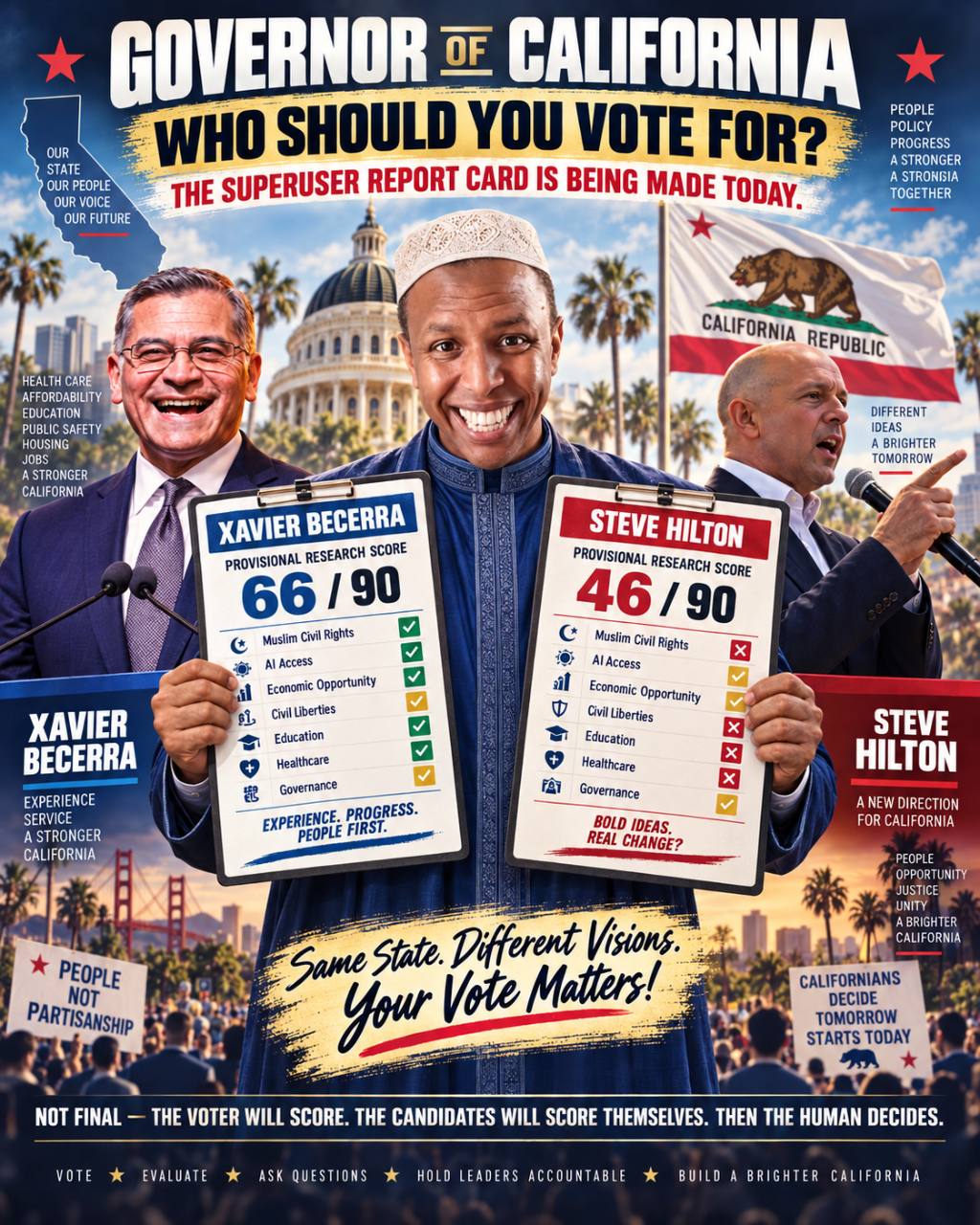
This opening report card begins with the two candidates identified in the Governor image: Xavier Becerra and Steve Hilton.
The image records a provisional research score of 66 / 90 for Xavier Becerra and a provisional research score of 46 / 90 for Steve Hilton.
These are not final voting instructions. They are the beginning of an open record covering Muslim civil rights, AI access, economic opportunity, civil liberties, education, healthcare, and governance.
NOT FINAL — THE VOTER WILL SCORE. THE CANDIDATES WILL SCORE THEMSELVES. THEN THE HUMAN DECIDES.
The research can be challenged. The candidates can answer. Voters can respond. Scores can be updated when the evidence changes.
This is the permanent Governor content stream. Future Governor articles, candidate responses, voter responses, score updates, and the final voting decision will continue here instead of replacing this introduction.